

Yelsea Anganga
Event Planning Expert · Amazing Theme Party Planners
12 Apr 2026
21 min read
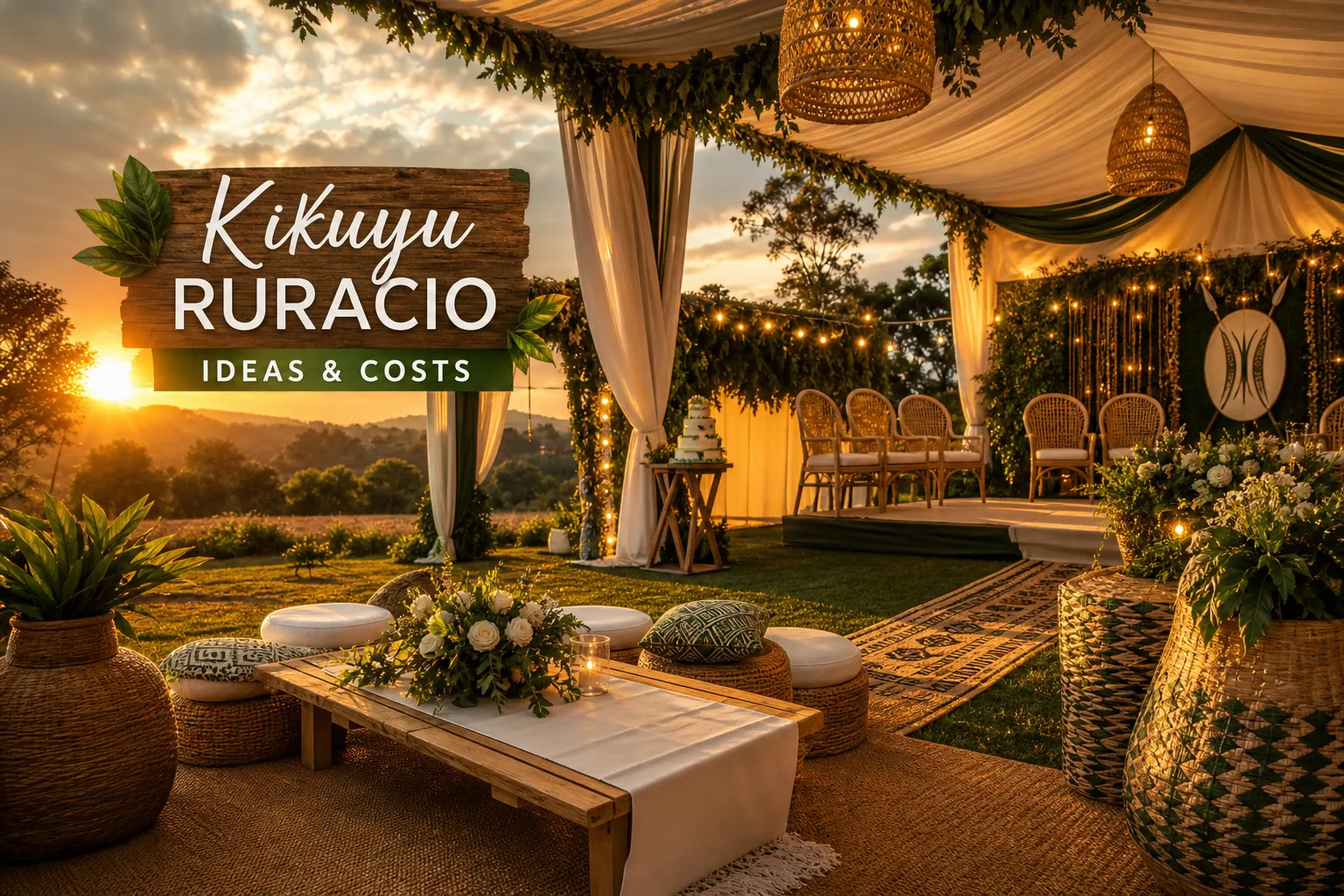
Kikuyu ruracio setup in Nairobi costs KES 40,000–150,000 depending on guest count and décor level — covering tent, elder seating, gift display zone, and formal gate area. Amazing Theme Party Planners has set up ruracio ceremonies across Nairobi and Kiambu with correct spatial layouts and elder zone separation.
Planning a Kikuyu ruracio setup begins long before the tent goes up or the chairs are arranged. The ululation starts before you even see the bride. The father's voice drops low, the room holds its breath, and then the yes comes, followed by a wave of sound that fills the tent, spills into the compound, and carries across the neighbourhood. At the centre of it all, a carefully arranged display of dowry items sits in full view: blankets folded with precision, calabashes gleaming, rams tethered nearby. Two families face each other across a room that has been arranged with deliberate intention, and every detail of that space is doing quiet, important work.
A ruracio is not a wedding reception with cultural decoration added on top. It is a structured negotiation between two families, governed by a sequence of rituals that have their own spatial logic. The gate-locking exchange happens at the entrance. The bride identification requires an open central floor. The dowry display needs a dedicated table with clear sightlines. The elders who conduct the negotiation must be positioned where they hold visible authority. None of this happens by accident, and none of it can be achieved with a generic party layout.
At Amazing Theme Party Planners, we have supported Kikuyu ruracio setups across Nairobi and the surrounding areas, and what we have learned is this: the best ruracio setups are built from the ceremony outward, not from the décor inward. This article walks you through every decision you need to make, from tent sizing and seating protocol to colour palette and realistic budget ranges, so that whether you are briefing a vendor or planning a significant part of it yourself, you walk in with full confidence.
What makes a Kikuyu ruracio setup different from other events
The ceremonies within a ruracio are not symbolic extras you can skip or reorder. They are a sequence, and that sequence dictates how your space must function. The gate-locking ritual requires a visible, accessible entrance zone where songs can be exchanged and a gate pass negotiated. The bride identification needs an open central floor where a group of identically dressed young women can stand without obstruction. The dowry negotiation needs elders seated in clear authority positions with a direct view of the display table. The shared cup of unity needs a private or screened area separate from the main gathering.
The key rituals and the physical spaces they require
The gate-locking ceremony opens proceedings at the compound entrance: the groom's women sing their plea to enter while the bride's aunts sing their refusal from inside, and a negotiated fee unlocks the gate. Your tent entrance must therefore be positioned and clearly framed so that both delegations can participate without crowding or confusion. Once inside, the bride identification ritual, known as gucagura muka wake, brings five to eight identically cloaked young women into an open space where the groom must find his bride without seeing her face. A floor plan with chairs pushed wall to wall will eliminate the space this ritual needs entirely.
The dowry negotiation, kuunirwo miti, is conducted by elders from both sides and centres on the arranged display of items: the mwati (ewe), harika (he-goat), ngoima (fattened rams), personal items for the bride's father, and household goods. This display must be visible and accessible to the negotiating elders. After agreement is reached, the shared cup of unity takes place privately before the general celebration resumes. For a clear description of the traditional dowry steps and what each element represents, see this ruracio dowry ceremony overview.
Why a ruracio cannot be set up like a wedding reception
A standard reception layout, round tables distributed evenly across the floor, all chairs facing a stage or dance floor, actively works against the ruracio's structure. A Kikuyu ruracio has two distinct delegations: the groom's side and the bride's family. These two groups must be seated in designated, separate zones that face each other or are clearly delineated, because the ceremony is fundamentally a dialogue between them. The negotiation needs to be visible to both sides simultaneously. Round tables scattered across the room do not create that dynamic. If you are comparing layouts, consider our Rustic Outdoor Party Packages Nairobi | Amazing Theme Party Planners which can be adapted to respect the ceremony's directional logic rather than imposing a generic reception format.
The role of elders and how their placement shapes the room
Elder positioning is not about courtesy or seniority in a social sense. The senior men and women who conduct the negotiation must be placed where they have unobstructed sightlines to the dowry display, easy access to each other, and visible authority over both delegations. In practical terms, this means the front rows or central positions on each side are reserved for elders first, with younger guests and children seated further back. When evaluating vendors, ask directly whether they understand elder positioning in a ruracio layout, it is one of the clearest indicators of genuine ceremony experience.
Traditional décor elements that anchor the ceremony
Authenticity in a Kikuyu ruracio setup is not about how much decoration you use, it is about which objects are present and whether they are positioned correctly. The items that matter most are the ceremonial ones, and they also function as the room's most powerful visual anchors. The subsections below cover the dowry display, cultural props, and textiles in turn. If you need help sourcing and dressing these elements, our Decorations for Hire Nairobi | Amazing Theme Party Planners service stocks culturally appropriate items and can work with your chosen Kitenge or colour palette.
The dowry display table: your ceremony's visual centrepiece
The dowry items are not background props. They are the focal point of the entire event, and the table or display area that holds them should be styled to communicate abundance, care, and respect. The ngoima (fattened rams) are typically tethered nearby in full view. Personal items for the bride's father, including a suit, shoes, hat, and walking stick, are arranged neatly and visibly. Household goods such as blankets, cooking pots (nyungu), and bedsheets are grouped by category and presented with intention. This is not a storage table; it is the room's centrepiece, and it deserves the same styling attention as a floral backdrop at any other event. Where a specific table shape is required we can provide options such as our Rustic Circular Table Hire Nairobi for Weddings & Events to suit the display.
Props with cultural meaning: blankets, calabashes, pots, and foliage
Beyond the dowry items themselves, a well-executed ruracio décor scheme draws on a set of traditional materials that serve as both ceremonial props and visual accents. Woven blankets (murengeti) add warmth and texture. Calabashes ground the space in heritage alongside clay pots already displayed on the dowry table. Muratina gourds, sugarcane, and banana leaves introduce natural organic forms that connect the indoor setup to the outdoor compound feeling most ruracio events are designed to evoke. These materials are generally low-cost and widely available from local markets, yet they do a great deal of cultural and visual work when placed thoughtfully.
How to incorporate traditional textiles without overdoing it
Kitenge and leso fabrics appear across successful ruracio setups: as table runners, chair ties, backdrop draping, and decorative accents at the entrance. The goal is cultural grounding, not theatrical excess. Choose one or two Kitenge patterns that anchor your colour palette and repeat them consistently across the space. Use the fabric as an accent, not a wallpaper. When the textile elements are restrained and intentional, they lift the whole aesthetic. When every surface is covered in competing patterns, the ceremony itself gets lost in the noise.
Kikuyu ruracio setup: choosing the right tent size for your guest list
Tent sizing is one of the most practically important decisions in your planning process, and underestimating your needs creates problems that are expensive to fix on the day. A ruracio also requires more open floor space than a dinner event of the same size, because the ceremony rituals need room to move.
Tent size benchmarks for 50, 100, 150, and 200+ guests
For up to 100 guests in a theatre-style arrangement, a 20×40 ft tent provides adequate coverage at roughly 1,000 to 1,200 square feet. For 100 to 150 guests, a 30×50 ft to 30×60 ft tent is the standard range, offering between 1,500 and 1,800 square feet. For 200 to 300 guests, you are looking at 40×60 ft to 40×80 ft, particularly for rural Kiambu or Muranga gatherings where community turnout is higher. Banquet-style arrangements require approximately 1,200 to 1,500 square feet for every 100 guests seated at rectangular tables, so budget your square footage accordingly when the event includes a shared meal. For a practical tent selection primer you may find this tent guide useful when assessing tent footprints and typical layouts.
Urban Nairobi ruracio events, where venue space is more constrained, typically host 80 to 150 guests. Rural gatherings in Kiambu and Muranga regularly reach 150 to 300 guests, which often means two interconnected tents or a single clearspan structure. If you are unsure of your final count, size up rather than down: a slightly oversized tent is far easier to manage than one that is too small to accommodate the ceremony flow. For additional guidance on effective tent sizing and how to convert guest lists into practical tent sizes, see this effective tent size guide.
Which tent type works best for a compound or home venue
For home compound venues, a high-peak canopy tent is the most common and versatile choice. It gives good interior height, creates a visually impressive gathering space, and can be configured with open or closed sides depending on the weather and the ceremony's open-air requirements. A-B line tents work well for larger compound setups where you need to cover a longer rectangular footprint. Frame shelters are ideal where the ground is uneven or where fixed anchor points are unavailable, as they do not require guy ropes that can restrict foot traffic. The gate-locking ritual specifically benefits from a tent configuration with an open or partially open entrance side so the singing exchange can be heard and witnessed clearly.
Allowing space for the ceremony flow, not just the seats
Add at least 200 to 400 square feet beyond your seating footprint for the ceremony flow itself. The bride identification ritual needs a clear central floor area that is not blocked by chair rows. The entrance zone needs visible framing so the gate ceremony reads as a formal threshold, not just a gap in the tent wall. The dowry display table needs buffer space on at least two sides so elders and representatives from both families can approach it without disrupting the seating arrangement. A ruracio that runs six to eight hours, from morning gate-locking to the late afternoon unity ceremony, needs a layout that accommodates movement across all those phases without constant furniture rearrangement mid-event.
Seating layouts for your Kikuyu ruracio setup
Seating at a ruracio is one of the most culturally specific elements of the entire setup, and it is where generic event hire companies most often get it wrong. The layout is not about aesthetics first; it is about protocol first, with aesthetics working within those boundaries.
Why seating at a ruracio follows gender and family lines
The groom's delegation and the bride's family are seated in separate, clearly designated sections. Within each delegation, men and women are traditionally separated. Elders from both sides occupy the front positions in their respective sections, closest to the dowry display and the negotiation space. This arrangement is not optional or adjustable based on personal preference. It is the structural grammar of the ceremony, and departing from it creates confusion for the elders conducting the negotiation and signals a lack of preparation to the families involved.
Layout options for different tent sizes and guest counts
For smaller gatherings of 50 to 80 guests, a facing-delegations arrangement works well: two blocks of chairs set in rows facing each other across a central aisle, with the dowry display table at one end visible to both sides and elders in the front rows. For medium gatherings of 100 to 150 guests, a U-shaped layout opens up the central floor for the bride identification ritual while giving elders on each arm of the U a clear sightline to the display area. As a general guide, rows no deeper than six chairs keep the elders in the front visible and in clear authority without isolating them from their own delegation. For larger events of 200 or more guests, a segmented banquet arrangement with delegation sections clearly separated by a central corridor allows more guests to be seated comfortably while maintaining the directional logic of the two-family structure. These layout options are starting points, your specific venue shape and family preferences may call for adjustments.
Blending protocol with comfort for urban Nairobi guests
Many Nairobi families include guests who have grown up at a distance from the full ceremonial protocol. Ushers placed at the tent entrance make an enormous practical difference, gently directing guests into the correct sections before they seat themselves incorrectly. Printed programmes, ideally in both Kikuyu and English, help guests follow the ceremony sequence and understand why the space is arranged as it is, a practice that many experienced planners recommend for urban ruracio events. Simple signage at each seating section removes ambiguity without requiring guests to ask repeatedly. These small additions make the ceremony run more smoothly and allow everyone to participate with confidence rather than confusion.
Colour palettes and modern styling that honour tradition
The Kikuyu ruracio has a clear visual vocabulary: earthy ochre, burnt orange, warm brown, ivory, and deep forest green. These colours echo the homestead aesthetic and the traditional regalia worn by elders. The challenge for modern Nairobi setups is translating that vocabulary into a space that feels rooted without looking like a museum reconstruction.
Colour combinations that feel Kikuyu without being costume-like
A palette built around terracotta, warm ochre, ivory, and forest green gives you a visually coherent space that reads immediately as culturally specific without reaching for theatrical "African décor" clichés. Choose one Kitenge pattern whose dominant colour pulls from this palette and use it as the accent thread across chair ties, table runners, and the entrance draping. When the accent colour is consistent and restrained, the space holds together visually. A single bold palette executed well reads far more intentionally than three competing colour schemes trying to cover every tradition at once.
How to style premium chairs without clashing with cultural décor
Ivory Tiffany chairs sit comfortably alongside traditional textile accents when the chair ties are cut from the same Kitenge or leso fabric used in the rest of the setup. The warm neutrality of the ivory frame picks up the earthy tones in the textiles rather than fighting them. For elder and VIP rows, Gold Chiavari chairs add a layer of distinction that feels appropriate to the seniority of the guests, provided the surrounding décor is anchored in earthy tones rather than bright or clashing colours. Clear Ghost chairs are another option worth considering: they recede into the background and let the cultural objects and textiles carry the visual weight of the space. These chair styles are sample choices, the right fit will depend on your overall palette and budget.
Lighting, foliage, and natural materials as finishing touches
Warm Edison bulb strings hung at tent height create an amber glow that complements the earthy colour palette and extends the comfortable, grounded atmosphere into the early evening if the celebration runs long. Banana leaf arrangements, sisal rope accents, and dried foliage at the entrance and around the dowry display reinforce the outdoor compound feeling that most ruracio events are designed to evoke. Natural materials tend to be among the highest-impact, lowest-cost additions available to you. They do not need a large budget, they need considered placement.
Realistic budget breakdown for a ruracio setup in Nairobi
Budgeting for a ruracio setup requires separating the event infrastructure (tent, chairs, tables, draping) from the ceremonial items (dowry goods, livestock, personal gifts) from the event services (catering, sound, generator, photography). This section covers the setup and décor costs, which are the area most families underestimate in early planning.
What a 50-guest ruracio setup costs and what it includes
A setup for approximately 50 guests typically falls in the KES 82,000 to KES 150,000 range. At the lower end of this range, you are covering basic tent hire, plastic or resin chairs, a simple dowry display table, and entry-level fabric draping at the entrance and around the display area. The setup is functional but light on visual impact. Moving from resin chairs to Tiffany chairs and a more considered fabric treatment, an upgrade that typically sits in the KES 95,000 to KES 100,000 range, begins to create a space that photographs well and feels genuinely curated. These figures are indicative estimates; your final quote will depend on specific vendor rates and delivery distances. Delivery and setup fees should be calculated from the outset, not added as a surprise at the end.
Scaling up: cost benchmarks for 100 and 150 guests
For 100 guests, the setup cost range sits between KES 150,000 and KES 300,000 depending on chair quality, tent specification, and décor depth. For 150 guests, expect KES 250,000 to KES 450,000 as your working range. Tent and furniture costs scale roughly in line with guest count, but décor cost does not have to. A well-designed 100-guest setup with a clear visual concept, quality chairs, and intentional cultural accents can be more impressive than a 150-guest setup where the budget has been spread too thin across too many items. Concentrate your décor investment on the dowry display table, the elder rows, and the tent entrance, and the rest of the space will follow.
Where to save and where cutting corners costs you more
Spend properly on tent quality, elder seating, the dowry display area, and professional delivery and setup. These are the elements that are visible throughout the entire event and that directly support the ceremony's function. Areas where simplification is acceptable include printed programmes (well-designed and simply printed is fine), some table florals (natural foliage replaces expensive cut flowers without visual loss), and favours. Never compromise on the setup timeline: a ruracio that runs for six to eight hours in all weather requires a tent that is properly erected and a layout that is correctly installed before guests arrive. That is not the area to save on.
How to brief your ruracio vendor and what to ask before signing
The question is not only whether you can brief a vendor properly, it is whether your vendor has the experience to receive that brief well. Cultural specificity requires cultural experience, and a long equipment catalogue is not a substitute for having set up at Kikuyu ruracio events before. Here is what to share upfront and what to ask in return.
The information every good vendor needs from you upfront
Before any vendor can quote accurately for a ruracio, they need the following:
- Your guest count and approximate delegation split
- The venue type (home compound, hired hall, or open ground)
- Whether a tent is required or already provided
- The ceremony sequence and expected timing
- Any gender-separation requirements you want structured into the layout
- The colour palette or Kitenge pattern you are working with
A vendor who quotes without asking most of these questions is working from a generic template, not from your ceremony's actual requirements.
Questions that reveal genuine Kikuyu ceremony experience
Ask these questions directly and listen carefully to the answers. Have you set up for a ruracio before? Do you understand delegation seating and can you implement it in the layout you propose? Can you configure the tent entrance to accommodate a gate-locking exchange? Have you styled a dowry display table before, and what does that typically include? How do you handle setup timing when the ceremony schedule shifts, as it often does? The vendors who answer these questions confidently and specifically are the ones who have done this work before. Those who pivot to describing their general inventory, without addressing the ceremony specifics, may not have the experience your event requires.
Why Amazing Theme Party Planners is built for this kind of event
Planning a Kikuyu ruracio setup demands more than good equipment, it demands an understanding of what the ceremony actually requires from a space. Amazing Theme Party Planners has supported ruracio events across Nairobi and the surrounding areas, and we understand the difference between a beautiful space and a functionally correct ceremony space. That understanding shapes every conversation we have with families from the very first message.
Our inventory includes ivory Tiffany chairs, Gold Chiavari chairs, Ghost chairs, high-peak canopy tents, and A-B line structures, all delivered and installed by our team. We know how to position elders, how to frame a dowry display, and how to configure a tent entrance for a gate-locking ceremony. Send us a WhatsApp message with your guest count, venue details, and ceremony requirements, and we will get a detailed, culturally informed quote back to you the same day. For families who want a setup that honours both the tradition and the occasion, that combination of knowledge and quality equipment makes a practical difference from the very first conversation.
For a practical checklist and planning notes that align with the ceremony sequencing described above, you may also find this ruracio planning guide helpful when preparing your vendor brief.
Start with the ceremony, then build the space around it
A ruracio is one of the most significant events a Kikuyu family will host. Two lineages formally recognise each other. A father gives his blessing. A son-in-law earns his place. The setup for that event should carry that weight in every decision you make, from how the chairs are arranged to where the dowry display sits to how the entrance frames the gate ceremony.
The decisions in front of you now are: what ceremony flow you are designing for, what tent size your guest count requires, which seating layout respects the protocol of your two delegations, what colour palette grounds the space without erasing its cultural identity, and which budget tier fits your total ambitions. Start with the ceremony sequence and work outward from there. Every other decision will be clearer once the ritual logic is mapped.
When you are ready to plan your Kikuyu ruracio setup, send Amazing Theme Party Planners a WhatsApp message with your guest count, venue location, and date. We will get a detailed, same-day quote back to you so that you can begin planning with real numbers and a vendor who understands exactly what your ceremony requires.
Frequently asked questions about Kikuyu ruracio setup
How much does a Kikuyu ruracio setup cost in Nairobi?
Setup costs vary by guest count and décor level. A 50-guest ruracio setup typically starts around KES 82,000 for a functional arrangement and can reach KES 150,000 for a more curated look with premium chairs and considered fabric treatment. For 100 guests, the range is broadly KES 150,000 to KES 300,000. These figures cover tent hire, seating, tables, and draping, ceremonial items and catering are budgeted separately.
What tent size do I need for a ruracio?
For 50 to 80 guests, a 20×40 ft tent is generally adequate. For 100 to 150 guests, a 30×50 ft to 30×60 ft tent is the standard range. For 200 or more guests, you will likely need a 40×60 ft to 40×80 ft structure or two interconnected tents. Add at least 200 to 400 square feet beyond your seating footprint to allow for the bride identification and gate-locking ceremony areas.
What is the correct seating layout for a ruracio?
A ruracio requires two clearly separated delegation zones, one for the groom's family and one for the bride's family, with elders in the front rows of each section. Men and women are traditionally seated separately within each delegation. A facing-delegations arrangement suits smaller gatherings; a U-shaped or segmented banquet layout works better for 100 or more guests.
What décor items are essential for a Kikuyu ruracio?
The dowry display table is the non-negotiable centrepiece, styled with the arranged items from both families. Beyond that, woven blankets (murengeti), clay pots, calabashes, Kitenge or leso fabric accents, and natural foliage such as banana leaves and sisal are the most culturally grounded additions. The entrance framing and elder seating deserve as much styling attention as any other area.
How do I find a vendor with genuine Kikuyu ruracio experience?
Ask specifically whether the vendor has set up for a ruracio before, whether they understand delegation seating, and whether they can configure a tent entrance for a gate-locking ceremony. Vendors with real experience will answer these questions directly. Those without it will typically redirect the conversation to their general inventory.
Can Amazing Theme Party Planners provide a same-day quote for a ruracio?
Yes. Send a WhatsApp message with your guest count, venue type, location, and event date, and we will respond with a detailed, itemised quote the same day. We cover Nairobi and the wider Kiambu and Muranga areas.
Frequently Asked Questions
Enjoyed this guide?
Share with someone planning an event
Browse Our Rental Catalogue
Check live availability and book your party essentials today.
View Rentals & BookStay Inspired
Follow @amazingthemepartieske for more
Live setups, décor reveals & real client moments — before, during & after every event
Follow on Instagram →Hire & Party Services in Nairobi
🎈 Kids Party Packages
Silver, Gold & Platinum tiers
🥂 Adult Event Packages
Picnic, Silver, Gold & Platinum
💍 Wedding Packages
Silver, Gold & Platinum tiers
🎨 Decoration Hire
Themes, florals & balloon décor
⛺ Tent & Equipment Hire
Tents, chairs, tables & more
🛒 All Party Rentals
Browse the full catalogue