

Yelsea Anganga
Event Planning Expert · Amazing Theme Party Planners
21 May 2026
18 min read
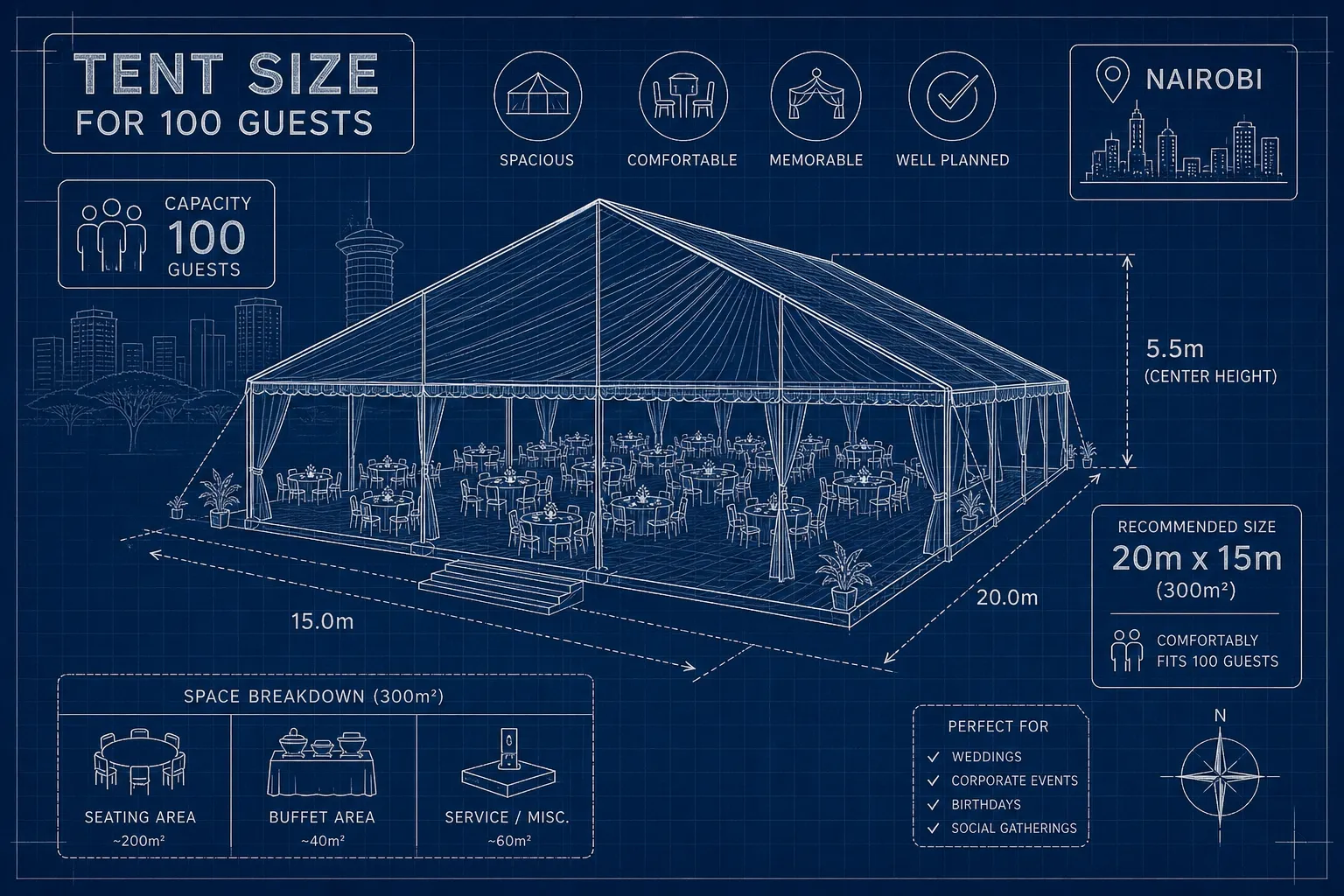
The correct tent size for 100 guests in Nairobi is 10×15m (150m²) for theatre seating or 12×20m (240m²) for a full dinner-dance setup — allow 1.1–1.4m² per seated guest. Amazing Theme Party Planners includes a free tent sizing recommendation with every quote. WhatsApp +254 792 788 442.
If you are asking yourself, "What size tent do I need for 100 guests in Nairobi?", you are already asking the right question. But the answer is not a single number. The most common mistake people make when hiring a tent for 100 guests is not about the tent at all. It is about the thought process that leads to choosing one: a rough headcount gets entered into a WhatsApp message to a supplier, a size gets confirmed, and everyone moves on. Then setup day arrives. Picture a family in Kilimani organising a wedding reception. The tent fits 100 chairs, exactly as ordered. But once the round tables go in, followed by the buffet line, the DJ booth, and a small dance floor, the guests end up pressed together with barely room to pull out a chair. The celebration happens, but not quite the way anyone imagined.
The right tent size for 100 guests is a calculation that depends on your event format, your feature list, and the physical realities of your venue. This guide walks you through that calculation precisely: the square-metre formulas used by experienced Nairobi tent hire teams, the actual dimensions stocked by local suppliers, the add-on features that quietly eat your floor space, and the budget framework to plan against. By the end, you will have a specific footprint in mind, not just a vague idea.
The space-per-guest formula that actually works
Every good tent decision starts not with a tent size but with a square-metre-per-guest figure. This number changes depending on how your event is structured, and getting it right before you call a supplier is what separates a comfortable event from an overcrowded one.
Seated banquet layout: the most space-hungry format
A seated dinner with round tables requires between 1.1 and 1.4 m² per guest. That range exists because plated service needs more elbow room per seat, and round tables, the standard in Nairobi for wedding receptions and celebrations, take up more floor space than rectangular ones. A standard 60-inch (152 cm) round table seats 6 to 8 guests comfortably, while a 72-inch (183 cm) table seats 8 to 10. Each table also needs 90 to 100 cm of clearance on all sides so guests can pull out their chairs and move freely. For 100 guests, the base calculation alone produces a requirement of 110 to 140 m², and that is before a single extra feature is factored in.
Cocktail reception: a smaller footprint, but only if managed well
A standing-and-circulating format requires 0.7 to 0.9 m² per guest. For 100 people, that puts your base footprint at 70 to 90 m², which sounds refreshingly compact. The catch is that a cocktail layout requires deliberate traffic flow planning. When guests cluster around food stations and bar areas without enough room to circulate freely, the tent feels uncomfortably tight even if the square meterage is technically sufficient. Plan for clear pathways between stations from the very beginning.
Theatre and presentation layouts: the tightest configuration
Rows of chairs facing a stage or screen need only 0.6 to 0.7 m² per guest, making this the most space-efficient format at 60 to 70 m² for 100 people. This setup is rarely used for social celebrations in Nairobi but is common for church events, harambee fundraisers, graduation ceremonies, and corporate briefings. If your event combines a presentation segment with a meal, plan for the larger banquet footprint rather than the theatre figure.
What size tent do I need for 100 guests in Nairobi? Exact dimensions explained
Translating those square-metre figures into actual tent sizes that Nairobi suppliers stock is the next step. Local suppliers quote in both metres and feet, so both measurement systems appear below. Save or screenshot this section before your next supplier call. For an additional practical reference, see a guide on what size tent you need for 100 guests.
The 30×40 ft (9×12 m) tent: the absolute minimum starting point
At 108 m², this tent sits slightly below the lower bound of the recommended seated banquet range (110 to 140 m² for 100 guests), making it a workable option only for the tightest plated dinner layouts, think close-set round tables with minimal aisle width and no station furniture on the floor. It suits a cocktail format or a simple plated dinner where food is served to the table and no buffet tables, bar counters, or DJ setups occupy floor space. The moment any of those features enter the picture, this size becomes genuinely tight. Think of the 9×12 m tent as your absolute minimum for a seated dinner, not your target.
The 40×40 ft (12×12 m) tent: a more comfortable seated dinner
At 144 m², this size provides approximately 1.44 m² per guest for a fully seated event, sitting near the top of the recommended banquet range. It accommodates a small serving station or bar at the edges without cutting into table space, and guests have enough clearance around each table to move without brushing past chairs at the next one. Most experienced Nairobi planners, including the team at Frame Tents for Hire in Nairobi | Amazing Theme Party Planners, recommend this as the baseline for 100 guests at a seated celebration.
The 40×50 ft (12×15 m) tent: when you want dancing and dining together
Once a dance floor enters the equation, the 12×12 m tent is no longer adequate. At 180 m², the 12×15 m footprint is the practical minimum for 100 guests who will both dine and dance. This size accounts for round dining tables plus a dance floor sized for 30 to 50 guests dancing simultaneously, the standard planning assumption for a lively celebration. If you also want a stage, buffet line, and bar, the next section explains exactly how those features affect this calculation.
How a dance floor, buffet, and stage change your tent size
Add-on features consume floor space faster than most people anticipate. Each element below carries a spatial cost, and the only way to arrive at an accurate total footprint is to list every feature before you choose your tent, not after.
Dance floor allocation: plan for 30 to 50% of your guest count
A common misconception is that a dance floor needs to fit all 100 guests at once. The standard planning assumption is that 30 to 50 percent of guests will dance at any given moment. For 100 guests, that means sizing for 30 to 50 people. Industry guidance typically allocates 0.37 to 0.46 m² per dancer, producing a dance floor requirement of roughly 20 to 25 m² for a modest crowd. For a fully comfortable floor where dancers move freely, allow 37 to 46 m². In practical terms, a 5×5 m area (25 m²) works for moderate dancing; a 6×7 m area (42 m²) suits a lively celebration where most guests take to the floor at some point. Add this figure directly on top of your base banquet calculation: 110 to 140 m² (base) plus 20 to 46 m² (dance floor) puts you at 130 to 186 m² before anything else is added. For more detailed guidance on choosing an appropriate dance floor size, read this practical article on how to choose the right dance floor size.
Buffet stations and bar areas: more space than most people expect
A standalone bar counter needs roughly 9 m², while a catering or buffet station takes approximately 18 to 19 m² depending on the number of serving points. Combined, a buffet-and-bar setup requires around 28 m² of floor space. That area is not just for the tables themselves but for the queue lines that form in front of them, which need at least 1.2 m of clearance so that waiting guests do not block movement across the tent. If your caterer is running a self-service setup with multiple dishes, err on the larger end of the range, and add that full 28 m² figure to your running total before confirming any tent size. For a complementary perspective on tent space when a dance floor is present, see what size tent for 100 guests with a dance floor.
Stage, DJ booth, and ceremony arches
A DJ booth with speakers and equipment needs a minimum of 9 m² (roughly 3×3 m). A live band stage for four musicians with amplification requires 22 to 25 m², which is a significant area inside a tent. A ceremony arch, floral backdrop, or sweetheart table used as a focal point adds another 2 to 4 m² at the front of the space.
The practical takeaway: list every feature on paper before you approach a supplier, assign a square-metre allocation to each one, and add them all to your base guest figure. That total is the minimum usable floor area your tent must provide.
Which tent type suits a 100-guest Nairobi event
Knowing the floor area you need is only half the decision. The tent structure itself must match your venue, your event style, and your budget. Nairobi suppliers stock several distinct structural options, each with different site requirements and visual outcomes.
A-B line tents: the workhorse for open-compound events
A-B line tents, also called marquee or pole tents, are commonly used for outdoor celebrations in Nairobi. Erected with central poles and anchor ropes, they need open ground and clear perimeter space of 2 to 3 m on all sides for the guy ropes. They suit garden and compound venues where nothing obstructs the perimeter, and they handle the footprints needed for 100-guest seated events with room to spare. Amazing Theme Party Planners supplies A-B line tents specifically suited to Nairobi compound setups, including ruracio ceremonies, graduation parties, and harambee gatherings at private residences across the city.
High-peak canopy tents: the premium choice for weddings and corporate events
The steepled roof peaks of a high-peak canopy create dramatic interior headroom, allow for elegant drapery installation, and shed rainwater faster than a flat-roof structure. These tents are a popular choice for wedding receptions and corporate galas in Nairobi: the interior volume, ceiling height, and drapery effect create a finished-venue quality that closed-sided frame tents cannot match. Amazing Theme Party Planners' high-peak canopy options work especially well on the 12×12 m to 12×15 m footprints needed for 100-guest seated events with a dance floor, where the additional interior height makes the space feel generous rather than enclosed.
Frame shelters and garden tents: for tight venues and rooftop spaces
Frame shelters require no centre poles and no external guy ropes, making them the right choice for venues with limited ground clearance: rooftop terraces, paved courtyards, tiled poolside areas, and compact gardens where an A-B line tent cannot anchor safely. Garden tents sit at the lighter structural end of the range and are well suited for baby showers, intimate birthday parties, and afternoon events of 50 to 80 guests. Amazing Theme Party Planners carries both frame shelter and garden tent options for clients whose venue cannot accommodate a full pole tent footprint, so the structural decision never has to limit your venue choice.
Nairobi's climate and how it shapes your tent decision
A tent sizing guide written for a Nairobi audience cannot treat weather as an afterthought. Nairobi's climate makes certain structural choices not merely preferable but practically necessary, depending on the time of year.
Rainy season planning: long rains and short rains
Nairobi's long rains run from mid-March to late May, with April as the wettest month averaging 84 mm of rainfall and May sometimes exceeding 135 mm in the central highlands. The short rains arrive from mid-November to mid-December at a lower but still meaningful intensity. Events booked during these months require tents with sealed sidewalls, adequate roof pitch for fast drainage, and a ground cover or flooring solution to prevent mud inside the tent. For local climate averages and monthly breakdowns, refer to the Average Weather in Nairobi, Kenya.
Local portable flooring is available for hire at approximately KES 300 per square metre, a worthwhile addition for any rainy-season event. A high-peak roof sheds water significantly faster than a flat-roof frame tent, which is one of the primary structural reasons the high-peak canopy is the preferred choice for wet-season celebrations in Nairobi.
Heat, ventilation, and the dry months
June through October brings Nairobi's dry season, with July recording as little as 2.5 mm of rainfall on average. This is the safest window for outdoor tented events from a weather risk perspective. January and February can produce intense midday heat at Nairobi's high elevation (approximately 1,700 to 1,800 m above sea level), making ventilation a real consideration for afternoon events. Open-sided tents with roll-up walls or mesh panels allow airflow and prevent the interior from becoming uncomfortable during peak afternoon temperatures. Discuss this with your supplier when briefing them on your event time of day.
Wind and the importance of proper anchoring
Nairobi's afternoon winds, particularly in June and July, can put significant lateral pressure on an improperly anchored tent. A-B line tents with correctly staked guy ropes and frame shelters bolted to a hard surface are both structurally adequate when installed by a competent team. What matters most is that the supplier conducts a site assessment before setup to determine appropriate anchor depth and spacing for your specific ground conditions. Never skip this step for a large outdoor event.
How to measure your venue before calling a supplier
Booking the right tent size starts with accurate site data. Arriving at a supplier conversation with real measurements, rather than estimates, saves time, prevents booking errors, and often results in a more accurate quote on the first call.
Measure the usable footprint, not just the open area
The total outdoor space at your venue is rarely equal to the usable footprint for a tent. Trees, boundary walls, parked vehicles, overhead power lines, and service access points all reduce the available area. The tent itself must fit within the usable footprint, and A-B line tents need an additional 2 to 3 m of clearance on all sides for anchor ropes. Measure the true clearable area, not the widest possible span of the garden.
Check the ground surface and gradient
Tent pegs cannot be driven into concrete or tiled surfaces without alternative anchoring methods such as water ballast barrels or frame bolt systems. A sloped site may require levelling or a raised flooring system, both of which add to the overall event cost and need to be flagged early. Walk the site with a tape measure and note the surface type and any visible slope before your supplier briefing.
What to include in your site brief to a tent hire company
A good site brief includes a rough sketch or photograph of the venue, the usable dimensions in metres, the surface type (grass, soil, or concrete), any overhead obstructions, and the access point for delivery trucks. When clients send this information via WhatsApp to Amazing Theme Party Planners, the team can prepare a same-day quote, eliminating the back-and-forth that commonly delays bookings by days. The more specific your brief, the faster and more accurate your quote.
What to budget for a 100-seater tent hire in Nairobi
Cost frameworks vary widely depending on tent type, and understanding the difference before you approach suppliers prevents unpleasant surprises when quotes arrive.
Basic canopy tents: the entry-level option
A basic PVC tarpaulin tent on a steel frame typically hires for KES 2,000 to 4,000 per day for a 100-seater. Delivery and installation are often priced separately at this level, and the total event cost can climb once sidewalls, flooring, and transport are added. These tents suit informal family gatherings, community fundraisers, and church events where budget is the primary constraint. For weddings and corporate functions where presentation is part of the event experience, they are not the most appropriate visual fit.
Premium structural tents: the all-in option for formal events
High-peak and heavy-duty aluminium frame tents for 100 guests are typically quoted in the KES 80,000 to 88,000 range per event, with delivery, erection, and interior lining commonly included at this price point. For celebrations where structural integrity, interior height, and visual presentation all matter, this investment delivers a noticeably different guest experience. Always confirm in writing exactly what is included in the quoted rate, tent, lining, sidewalls, delivery, erection, and dismantling should all be specified before you confirm a booking.
Permits and site compliance: budget for this from the start
Events held at public open spaces in Nairobi require a permit from the Nairobi County Public Open Spaces Department, with tent pitching in parks costing KES 10,000 per day. Night events at both public and private venues may require a short-term noise permit. All events must maintain clear exit paths and have fire extinguishers on site. Private residential venues are less regulated, but fire safety compliance and crowd management planning are still expected. Raise compliance requirements with both your venue manager and your tent supplier early in the planning process, not on setup day.
Scaling the formula: tent sizes from 50 to 300+ guests
The same calculation logic that works for 100 guests applies across the full range of event sizes. Use this section as a reference point whenever your guest count shifts.
Intimate gatherings of 50 to 80 guests
At 50 to 80 guests, a 6×12 m (20×40 ft) to 9×9 m (30×30 ft) tent covers a comfortable seated dinner. A garden tent or compact frame shelter works well at this scale and is significantly easier to fit into smaller Nairobi compounds without the clearance demands of a full A-B line structure. This size range is particularly popular for baby showers, kids' birthday parties, and intimate introduction ceremonies.
Medium events of 150 to 200 guests
At 150 to 200 guests, move to a 12×18 m (40×60 ft) or 12×21 m (40×70 ft) footprint for a seated dinner with a dance floor. The structural load of a tent this size demands proper anchoring and warrants a premium structural option over a basic canopy. At this scale, the investment in a high-peak canopy pays off in stability, headroom, and the overall impression the space makes on arriving guests.
Large gatherings of 300 or more guests
At 300 or more guests, the minimum seated banquet footprint exceeds 330 m², which often means connecting two tent modules side by side or commissioning a large-format structure on an open-compound site. Amazing Theme Party Planners' range extends to configurations that accommodate this scale, such as the 20x30m High Peak Tent Hire Nairobi | 300 Guest Event Tent, with the same attentive delivery and setup service used for smaller events. Whether the gathering is a large ruracio, a church harambee, or a corporate gala, the planning methodology remains identical: start with the per-guest formula, add your feature allocations, measure your site, and build from there.
Frequently asked questions: what size tent do I need for 100 guests in Nairobi?
What is the minimum tent size for 100 guests at a seated dinner?
The minimum is a 30×40 ft (9×12 m) tent at 108 m², though this leaves very little buffer. A 40×40 ft (12×12 m) tent at 144 m² is the recommended baseline for a comfortable seated dinner with 100 guests in Nairobi.
What size tent do I need for 100 guests with a dance floor included?
Allow a 40×50 ft (12×15 m) tent at 180 m² as the practical minimum. If you are also adding a buffet station, bar, and DJ booth, a 12×18 m footprint gives you considerably more working room. For further reading on tent sizes when a dance floor is present, consult a specialist guide on what size tent for 100 guests with a dance floor.
How much does a 100-seater tent hire cost in Nairobi?
Basic canopy tents start at KES 2,000 to 4,000 per day. Premium high-peak structural tents for 100 guests are typically quoted between KES 80,000 and KES 88,000 per event, inclusive of delivery, erection, and lining.
Which tent type is best for a wedding reception of 100 guests in Nairobi?
A high-peak canopy tent on a 12×12 m to 12×15 m footprint is the most suitable choice. It offers the interior height for drapery, faster rainwater drainage, and a finished venue appearance that suits formal celebrations.
Choose the right tent, then enjoy the celebration
The single most useful action you can take after reading this guide is to measure your venue before you call anyone. Know your usable footprint, decide on your event format, list every feature that will occupy floor space, and arrive at a specific square-meterage requirement. That number is what you share with a supplier, not a guest count on its own.
The difference between a well-sized tent and a poorly sized one is felt by every guest at the event. It shows up in how freely people move between tables, how the dance floor fills without anyone bumping into a buffet queue, and how the overall space feels considered rather than improvised. Getting this right is not a luxury reserved for large budgets; it is a planning discipline that any event, at any price point, can apply.
If you are still wondering what size tent you need for 100 guests in Nairobi, the answer starts with your venue measurements and event feature list. Send Amazing Theme Party Planners your site dimensions and event brief via WhatsApp, and the team will recommend the exact footprint and tent structure that fits your celebration. If you already know you prefer a stretch style, view our Stretch Tent Hire Nairobi 100 Seater | Amazing Parties to see layout options and sizing for that tent style. You now have the formula, the next step is putting it to work.
Frequently Asked Questions
Enjoyed this guide?
Share with someone planning an event
Browse Our Rental Catalogue
Check live availability and book your party essentials today.
View Rentals & BookStay Inspired
Follow @amazingthemepartieske for more
Live setups, décor reveals & real client moments — before, during & after every event
Follow on Instagram →Related Articles
B-Line Tent Hire in Nairobi: Sizes, Uses & Setup Guide
A B-line tent is a modular rectangular/square frame style (not a brand) — lightweight 6061/T6 anodized aluminum with hot-dip-galvanized joints and PVC-coated vinyl panels
Tent Hiring in Nairobi: Sizes, Costs and How to Book Right
The guide from Amazing Theme Party Planners helps you pick the right tent in Nairobi with 2026 price benchmarks, a size guide from 3x3m canopies to large marquees .
Tent hire in Nairobi: sizes, real prices and how to book
Plan tent hire in Nairobi with confidence: learn tent types, exact sizing for guest counts, realistic prices, and step-by-step booking tips to avoid surprises.
Hire & Party Services in Nairobi
🎈 Kids Party Packages
Silver, Gold & Platinum tiers
🥂 Adult Event Packages
Picnic, Silver, Gold & Platinum
💍 Wedding Packages
Silver, Gold & Platinum tiers
🎨 Decoration Hire
Themes, florals & balloon décor
⛺ Tent & Equipment Hire
Tents, chairs, tables & more
🛒 All Party Rentals
Browse the full catalogue