

Yelsea Anganga
Event Planning Expert · Amazing Theme Party Planners
27 Apr 2026
19 min read
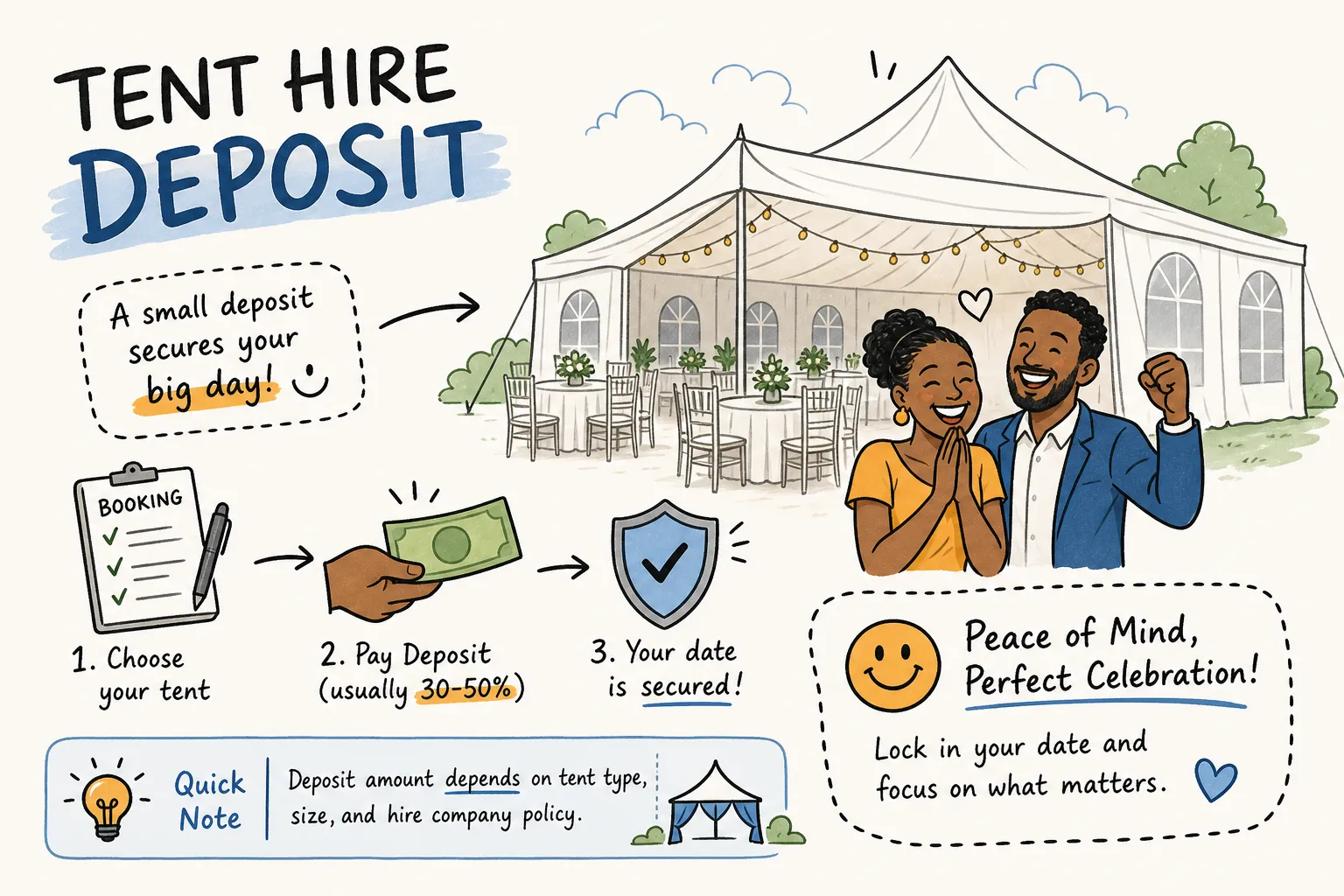
Tent hire deposits in Nairobi are typically 50% of the total cost, paid via M-Pesa to confirm your booking date. Amazing Theme Party Planners charges a 50% deposit with the balance due before delivery — and issues written confirmation immediately on payment. Always insist on written confirmation from any supplier.
If you've ever wondered what deposit is required to hire a tent in Nairobi, you are not alone. You've found the tent you want, the vendor has sent a quote that looks reasonable, and then comes the message: "Please send 50% via M-Pesa to confirm your booking." Suddenly you're staring at a five-figure number on your phone screen, wondering whether this is completely normal or whether someone is about to disappear with your money.
It is normal. Deposit rates in Nairobi's tent hire market commonly vary between about 20% and 50%, and not every vendor operates the same way. Some ask for 50% upfront. Others work with 20, 30%. A few charge a small flat booking fee before anything else. Understanding these differences before you start calling around puts you in a much stronger position to compare quotes, ask the right questions, and make a confident decision.
This guide walks you through exactly what to expect: the typical tent hire deposit percentages, what those figures look like in actual shillings for different tent sizes, how payment works, what cancellation terms to watch for, and what you should have in writing before you transfer a single cent. Vendors like Amazing Theme Party Planners make it standard practice to share all of this information upfront, but not every company in Nairobi is as transparent. Knowing what to ask protects you regardless of who you book with.
What is the deposit required to hire a tent in Nairobi, and why do vendors ask for it?
A deposit is not a cash grab, even when it feels like one. When a vendor agrees to your event date, they are making a real business commitment. A 50-seater high-peak canopy assigned to your function on 14th December cannot go to the corporate client who calls the following day for the same date. The deposit compensates the vendor for that lost revenue opportunity and covers the early logistics work that begins the moment your date is confirmed.
Beyond reserving the physical equipment, a deposit also blocks the delivery crew's schedule, triggers the procurement of any items that need to be sourced or prepared specifically for your setup, and initiates route planning for your location. For large tent structures requiring lighting rigs, flooring panels, and generator coordination, that preparation work starts weeks in advance. The deposit funds the process.
From your side, a paid deposit creates something equally valuable: a documented, time-stamped record that commits both parties. An M-Pesa confirmation with a transaction code, combined with a written booking form, provides strong evidence of a booking and is generally sufficient to establish payment priority, though enforceability ultimately depends on the contract and applicable law. Clients who pay nothing have no documented priority. Clients who pay a tent hire deposit in Nairobi have a dated, traceable record of their booking slot, and that record is their protection if a dispute ever arises.
Standard deposit percentages across Nairobi tent hire vendors
The 50% benchmark and where it comes from
The most widely quoted figure in the tent rental deposit Kenya market is a 50% advance deposit to secure the booking date, with the balance due on or after delivery and setup. Established providers such as Rodmer Events publish this explicitly: 50% of the total price is required to book services for a specified date. This is not an arbitrary number. It reflects a threshold that covers the vendor's sunk costs while keeping the booking financially accessible for the client.
At 50%, both parties have meaningful skin in the game. The vendor has enough to justify turning away other clients. The client has paid enough that walking away is genuinely costly, which reduces last-minute cancellations for the vendor. It is a structure that has become a de facto standard in Nairobi precisely because it works for both sides.
Vendors who ask for less (20, 30%) and why
Some Nairobi tent hire companies, particularly those competing on accessibility or maintaining relationships with repeat corporate clients, operate on a 20, 30% booking deposit. This lower entry point is more likely when you are booking well in advance (eight or more weeks before your event), when the total order value is large, or when you have a documented history with the vendor. Corporate clients working through company procurement processes often negotiate reduced initial deposits because their organisations represent reliable, repeat business.
If you are booking a medium or large tent during a less competitive period, a 30% deposit is a perfectly reasonable figure to ask for. The vendor still has a meaningful financial commitment from you, and you preserve more cash flow until closer to the event date.
One-time non-refundable booking fees
Some smaller and more informal vendors in Nairobi charge a flat fee, reported variously at around KSh 500 to KSh 2,000 on social media listings, just to hold the date before the main deposit is due. This is a booking confirmation fee, not the deposit itself, and the two should not be confused. If a vendor is asking you to pay a small amount now and a larger deposit later, clarify in writing whether the initial fee is absorbed into the total or whether it is an additional charge on top of everything else.
Deposit amounts in KSh: what the deposit required to hire a tent in Nairobi looks like by tent size
Small tents (10, 30 guests): roughly KSh 3,000, 17,500 upfront
For a small tent suitable for 10 to 30 guests, the total rental cost in Nairobi typically falls between KSh 15,000 and KSh 35,000. At a 20, 30% deposit rate, you are looking at roughly KSh 3,000 to KSh 10,000 upfront. At the 50% benchmark, that range shifts to KSh 7,500 to KSh 17,500. Picture a garden birthday party for 25 guests in Kilimani: a 15×20 ft frame shelter at KSh 25,000 total means a 30% deposit of KSh 7,500, with the remaining KSh 17,500 due on the day of setup.
This is the most accessible category for home events, and the deposit amounts are manageable for most families. That said, do not let the smaller numbers make you less rigorous about getting the terms in writing. The same cancellation and documentation rules apply regardless of tent size.
Medium tents (50, 100 guests): roughly KSh 9,000, 45,000 upfront
The medium tent bracket is the most common for Nairobi home events and garden parties. Total rental costs for 50 to 100-guest structures generally sit between KSh 45,000 and KSh 90,000. Aquilla Tents, for instance, prices a 50-seater tent at approximately KSh 52,000; a 30% deposit on that figure comes to around KSh 15,600. Across the broader range, a 30% deposit puts you between KSh 9,000 and KSh 27,000 upfront, while an 80% deposit on the upper end reaches roughly KSh 45,000.
This is the bracket where negotiating the deposit percentage is most worth attempting. The total order value is large enough that a vendor has genuine incentive to work with a well-prepared client, particularly one booking four to six weeks in advance or combining tent hire with chair and décor hire from the same company. A bundled order from a single vendor tends to unlock more flexibility on payment structure. For additional context on market pricing you can see a typical example of the cost of a 100-seater tent in Kenya.
Large tents (150+ guests): roughly KSh 25,000, 75,000 upfront
For events requiring 30×40 ft to 40×60 ft structures, total rental costs run from KSh 110,000 to KSh 250,000 and above. At this scale, vendors consistently push toward the higher end of the deposit range, typically 40, 50%, because the logistics commitment is substantially greater. These bookings often involve lighting, flooring, generator coordination, and multiple crew members working across an entire day. The deposit needs to reflect that operational commitment.
In practical terms, a 40% deposit on a KSh 150,000 large-tent package means KSh 60,000 upfront. At 50%, that becomes KSh 75,000. Clients booking at this scale should budget for the deposit well in advance and avoid treating it as a figure they can negotiate down to token levels. The vendor's operational investment at this size is real, and a meaningful deposit is a fair reflection of that.
How to pay your tent hire deposit in Nairobi
M-Pesa and bank transfer: the two dominant methods
M-Pesa is the fastest and most practical deposit method for tent hire in Nairobi. Most vendors provide either a personal M-Pesa number or a Lipa na M-Pesa PayBill number, and the transaction completes instantly. Safaricom sends an automatic SMS confirmation with a unique transaction code the moment the payment goes through, giving you an immediate digital record. Always save that SMS and screenshot it as a backup.
The M-Pesa confirmation alone is not sufficient, however. Always request an official payment receipt or booking confirmation from the vendor, explicitly stating what the payment covers, the total hire cost, and the balance remaining. A reputable vendor will provide this promptly, either via WhatsApp or email. If a vendor cannot send you a written confirmation after receiving your advance deposit for tent hire, treat that as a serious warning sign.
Bank transfer is equally accepted, particularly for larger orders or corporate clients working through finance departments. The process takes slightly longer to clear, so factor that in when booking close to your event date. Some vendors will not confirm the booking until the transfer reflects in their account, which can add one to two business days to your timeline.
Pay-after-delivery offers: available but not universal
Some Nairobi tent hire companies do advertise pay-after-delivery arrangements, particularly for local deliveries within Nairobi. This is vendor-specific and not a market-wide standard. Where it is available, it typically applies to clients with a prior booking history with that vendor, short delivery distances, and full payment on the day of setup before the crew leaves the site. Do not assume this option is available unless the vendor explicitly confirms it in writing for your specific booking.
How Amazing Theme Party Planners handles the payment process
Amazing Theme Party Planners aims to make the payment stage as straightforward as possible. When you send a WhatsApp enquiry, you receive a full cost breakdown covering the tent size and type, delivery fee, deposit amount, balance figure, and balance due date, so you know precisely what you are committing to before you transfer anything. Both M-Pesa and bank transfer are accepted for the deposit. That kind of upfront transparency is what a good vendor relationship should look like from the very first message.
Booking timelines: when to pay and when the balance falls due
How far in advance you should secure your tent hire
Popular dates in Nairobi fill up faster than most clients expect. December holiday parties, Easter weekend events, end-of-year school celebrations, and busy wedding seasons in January and August regularly see vendors fully booked weeks in advance. For medium-sized events of 50 to 100 guests, booking four to six weeks out gives you a reasonable selection of tent options and some negotiating room on deposit terms. For large outdoor functions of 150 guests and above, eight to twelve weeks is a more realistic planning horizon.
The deposit is due at the point of booking confirmation, not the week before your event. Some clients try to reserve a date verbally and pay the deposit later. Most reputable vendors will not hold a date without a confirmed payment, and understandably so. If the date you want is available today, pay the deposit today.
When vendors expect the balance payment
The most common tent hire payment terms in Nairobi are deposit at booking and balance due on or after delivery and setup. This means you pay the remaining amount, 50% or 70%, depending on your initial deposit percentage, once the tent is erected at your venue and you are satisfied with the setup. Some vendors require full payment before they load the truck, particularly for first-time clients or long-distance deliveries outside Nairobi.
Both structures are legitimate, but you need to confirm which applies to your booking before you pay the deposit. A vendor who tells you verbally that the balance is due after delivery, but whose booking form states full payment before dispatch, will enforce the written terms. Ask the question, get the answer in writing, and make sure it matches what appears in any contract or booking confirmation you sign.
Cancellation policies and what happens to your deposit
The sliding-scale refund structure most vendors use
The tent hire cancellation and refund policy in Nairobi is not standardised across all vendors, but the most common pattern follows a tiered structure. Cancellations made 30 or more days before the event typically attract a minimal penalty, sometimes just the small booking fee if one was charged. Cancellations between 14 and 30 days before the event usually result in partial forfeiture of the deposit, commonly around 50%. Cancellations inside 7 to 14 days of the event typically mean the full deposit is lost.
To illustrate: if you paid a KSh 20,000 deposit on a medium tent hire and cancelled eight days before your event, many vendors' terms would result in you forfeiting that entire amount, though the exact outcome depends on the specific time bands and percentages in your contract. Always check the written policy before committing. That is not punitive; it reflects the reality that the vendor can no longer book another client for that date at such short notice.
Date changes and rescheduling: what to realistically expect
Most vendors allow one date change subject to availability, but this is not a guaranteed right. If the new date you want is already booked, the vendor cannot simply move another client to accommodate you. Rescheduling is also not always free; some vendors charge an administrative fee or apply a price difference if the new date falls in a higher-demand period.
Verbal assurances carry no legal weight here. A vendor saying "no problem, just let us know" during an initial conversation is not a written rescheduling clause. Before you pay any deposit, ask for the rescheduling policy in writing, specifically whether one free date change is permitted, within what timeframe, and whether availability is confirmed at the point of the original booking or only when you request the change.
Why getting cancellation terms in writing matters
The contract governs everything. No market norm, no WhatsApp conversation, and no verbal agreement overrides what appears in the vendor's booking form or hire agreement. If a vendor does not provide a written contract or booking confirmation, request one before transferring any money. A professional vendor will have standard terms and will not hesitate to share them. If someone resists putting the cancellation policy in writing, that resistance is itself a reason to pause.
ID checks, security requirements, and documentation to prepare
What identification tent hire vendors typically request
Reputable Nairobi tent hire companies require a valid national ID or passport before releasing equipment or confirming delivery. Some vendors ask for this at the point of booking alongside the deposit; others request it on setup day when the crew arrives at your venue. Either way, this is a normal, protective requirement for both parties. It creates a documented record of who hired the equipment, which matters if anything is damaged or goes missing during the hire period.
Corporate clients are sometimes also asked for a company PIN certificate or a letter on company letterhead. If you are booking on behalf of an organisation, check with the vendor in advance whether additional documentation is needed so there are no delays on setup day.
Security deposits vs. hire deposits: the key difference
Some vendors charge a refundable security deposit for event tents on top of the standard hire deposit, specifically to cover potential damage to equipment during the hire period. This is more common with premium tent structures, Tiffany chairs, Chiavari chairs, and other high-value inventory pieces. The security deposit is held and returned after the equipment is collected and inspected.
Before you transfer any money, ask the vendor to specify clearly: which portion of what you are paying is the hire deposit (non-refundable or tiered), and which portion, if any, is a refundable security deposit. Get the refund conditions in writing, including the timeframe for return and the process for raising a dispute if deductions are made. These are reasonable questions and a professional vendor will answer them without hesitation.
Tips to reduce your upfront cost and book with confidence
Strategies for negotiating a lower deposit percentage
There are several practical ways to reduce the proportion you pay upfront without compromising the booking. Booking well in advance, ideally eight or more weeks before the event, signals to the vendor that the risk of a last-minute cancellation is lower, which gives you leverage to propose a 30% deposit instead of 50%. Providing proof of a previous successful event, a past booking reference, or a referral from another client the vendor has worked with all carry weight in this conversation.
Combining your tent hire with chair hire, décor, or other services from the same vendor increases your total order value and gives the vendor a stronger reason to accommodate a lower tent booking deposit percentage. Some vendors also offer a small discount for clients who pay the full amount upfront rather than in instalments; if your cash flow allows it, ask whether this option is available.
Red flags that suggest a vendor is not trustworthy
Watch for these warning signs before you transfer anything: no written quote, only a verbal price; no payment confirmation after receiving your deposit; no physical address or verifiable contact details; pressure to pay in cash with no receipt; and an inability or unwillingness to provide a booking contract. A genuine tent hire business has nothing to hide in any of these areas. Professional vendors provide documentation because it protects them as much as it protects you.
Getting a clear cost breakdown before you commit
The anxiety most clients feel around tent hire deposits comes down to one thing: not knowing exactly what they are agreeing to. That problem disappears when the vendor gives you a full, itemised breakdown before you pay anything. Amazing Theme Party Planners does this as standard practice. Send a WhatsApp message with your event date, guest count, and location, and you receive a complete quote that includes the tent size and type, the delivery fee based on your specific distance, the deposit amount required to confirm the booking, and the balance due date. Every number is on paper before a single shilling moves.
That kind of clarity is what the booking conversation should always look like. It removes guesswork, prevents cash-flow surprises, and lets you compare vendors fairly on a like-for-like basis. When you know the exact deposit figure upfront, the decision becomes straightforward.
What to take away from this guide
Most Nairobi tent hire vendors ask for a deposit in the range of 20, 50% as an advance payment, with the balance due on or after delivery and setup. In shillings, that ranges from around KSh 5,000 for a small garden tent to KSh 75,000 for a large event structure covering 150 or more guests. M-Pesa is the fastest and most common payment method, bank transfer is equally accepted for larger orders, and pay-after-delivery exists but is not a universal option.
Cancellation terms follow a sliding scale: the closer to your event date, the more of your deposit you forfeit. One date change is commonly permitted, but availability is never guaranteed. A valid national ID or passport is a standard documentation requirement, and any refundable security deposit should be explicitly distinguished from the hire deposit in writing before you pay.
Now you know what the deposit required to hire a tent in Nairobi typically looks like across different tent sizes and vendor types. The most important advice in this entire guide remains this: confirm every term in writing before you transfer anything. A trustworthy vendor expects those questions and answers them clearly. If you want a no-surprise quote for your next event, WhatsApp Amazing Theme Party Planners today. You will receive the full cost breakdown, including the exact tent hire deposit amount needed to lock in your date, with nothing hidden and nothing left to guess.
Frequently asked questions about tent hire deposits in Nairobi
For more general information and quick answers, see our FAQs.
What is the deposit required to hire a tent in Nairobi?
Most Nairobi tent hire vendors require a deposit of between 20% and 50% of the total hire cost to confirm your booking. The 50% figure is the most common benchmark among established providers, though clients booking well in advance or placing large orders can sometimes negotiate a lower percentage of around 20, 30%.
Is the tent hire deposit refundable?
Generally, the booking deposit is non-refundable or subject to a tiered refund depending on how far in advance you cancel. Cancellations made more than 30 days before the event may attract minimal or no penalty; those made within 7, 14 days typically result in full forfeiture. Always confirm the specific policy in writing with your vendor before paying.
Can I pay the tent hire deposit via M-Pesa?
Yes. M-Pesa is the dominant payment method for tent hire deposits in Nairobi. Most vendors accept payment via a personal M-Pesa number or a Lipa na M-Pesa PayBill. Always request a written receipt or booking confirmation after the transaction, as the M-Pesa SMS alone is not sufficient documentation.
What is a security deposit, and is it different from the hire deposit?
Yes, these are two separate payments. The hire deposit secures your booking date and is typically non-refundable (or tiered). A security deposit, charged by some vendors on high-value equipment, is refundable after the equipment is collected and inspected. Ask your vendor to clarify both amounts in writing before you pay anything.
How early should I book and pay the deposit for a tent in Nairobi?
For medium events of 50, 100 guests, booking four to six weeks in advance is advisable. For large events of 150 guests and above, aim for eight to twelve weeks ahead. Popular dates such as December, Easter, and peak wedding months fill up quickly, so paying your deposit as soon as your date and venue are confirmed is the safest approach.
Frequently Asked Questions
Enjoyed this guide?
Share with someone planning an event
Browse Our Rental Catalogue
Check live availability and book your party essentials today.
View Rentals & BookStay Inspired
Follow @amazingthemepartieske for more
Live setups, décor reveals & real client moments — before, during & after every event
Follow on Instagram →Related Articles

B-Line Tent Hire in Nairobi: Sizes, Uses & Setup Guide
A B-line tent is a modular rectangular/square frame style (not a brand) — lightweight 6061/T6 anodized aluminum with hot-dip-galvanized joints and PVC-coated vinyl panels
Tent Hiring in Nairobi: Sizes, Costs and How to Book Right
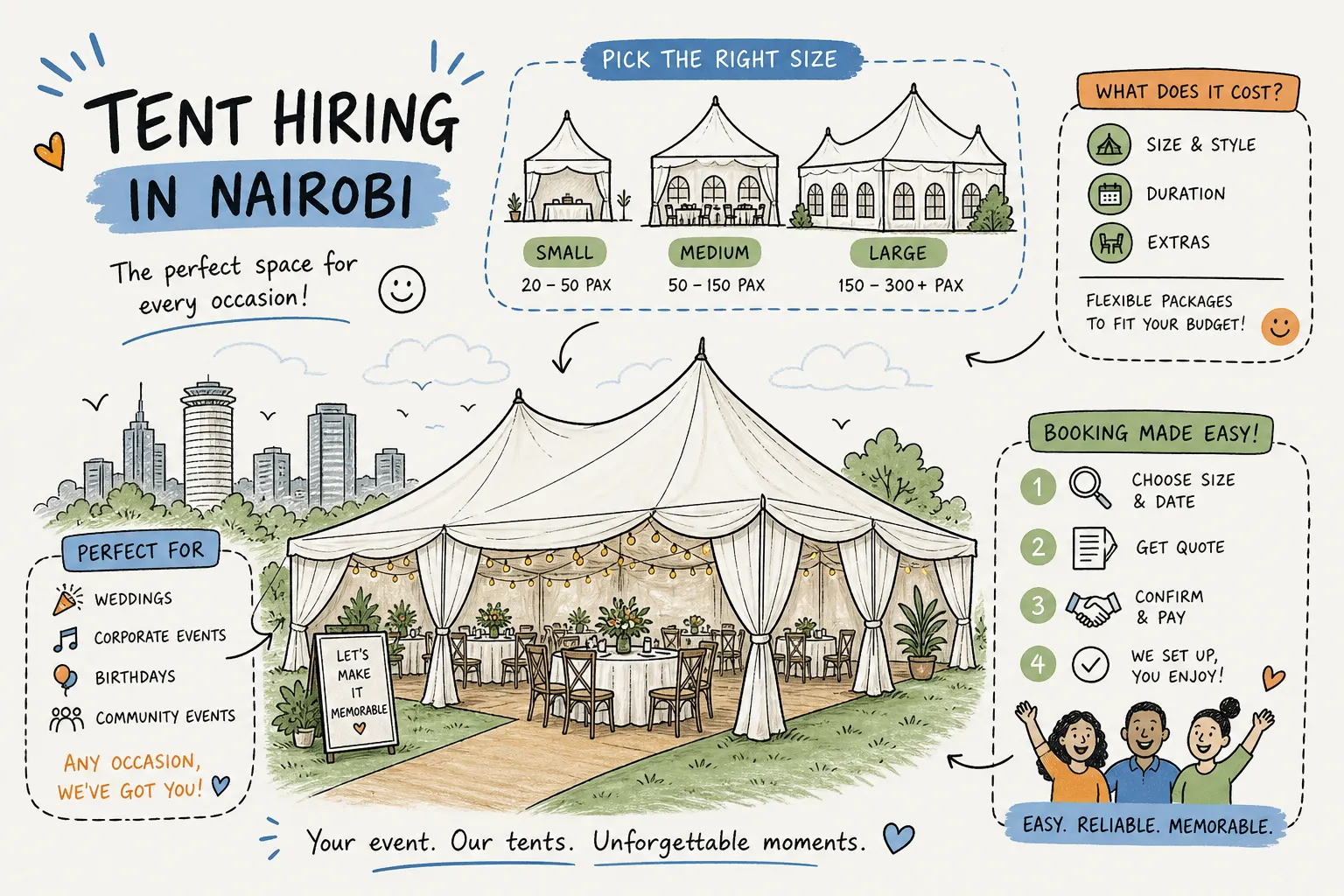
The guide from Amazing Theme Party Planners helps you pick the right tent in Nairobi with 2026 price benchmarks, a size guide from 3x3m canopies to large marquees .
Tent hire in Nairobi: sizes, real prices and how to book
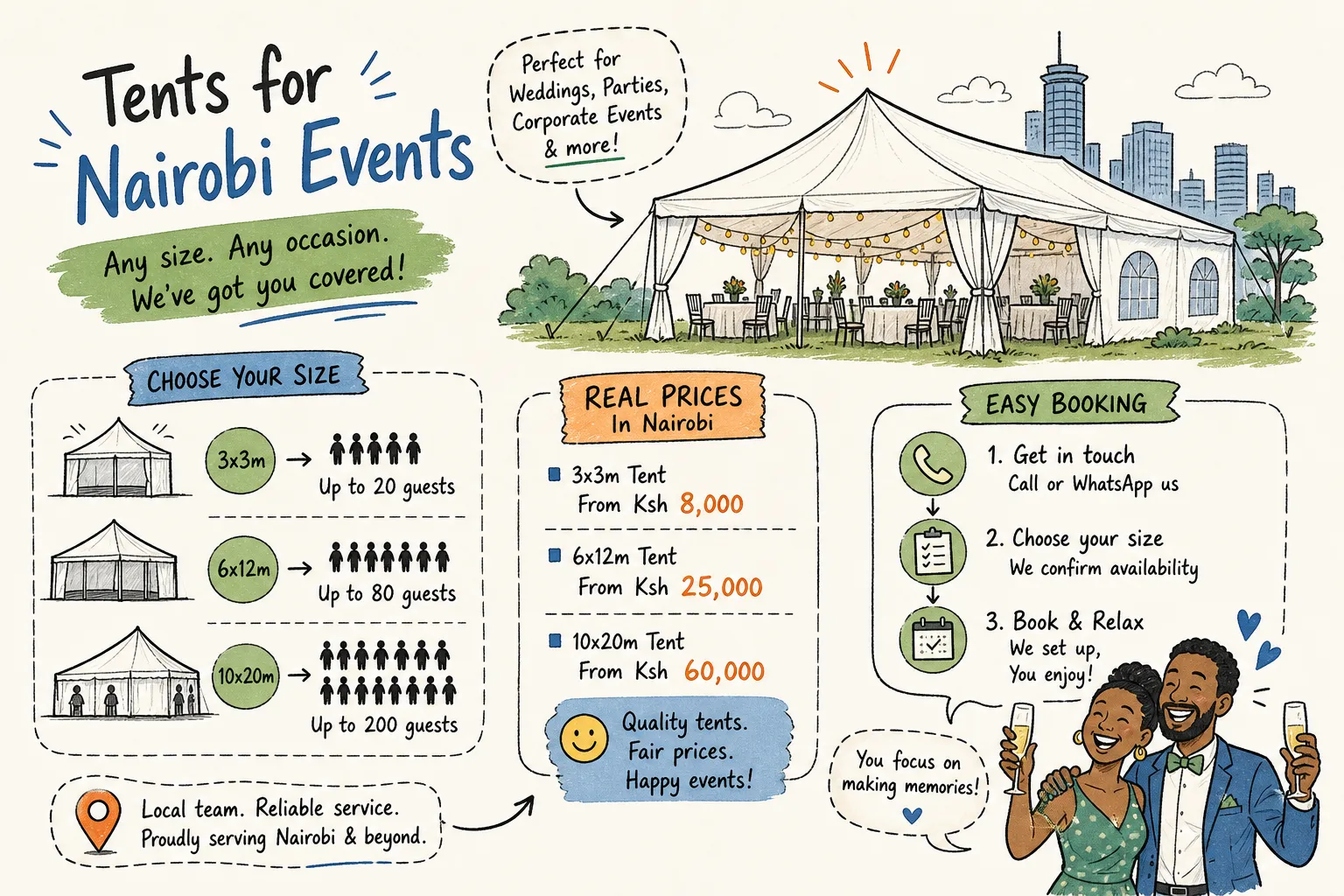
Plan tent hire in Nairobi with confidence: learn tent types, exact sizing for guest counts, realistic prices, and step-by-step booking tips to avoid surprises.
Hire & Party Services in Nairobi
🎈 Kids Party Packages
Silver, Gold & Platinum tiers
🥂 Adult Event Packages
Picnic, Silver, Gold & Platinum
💍 Wedding Packages
Silver, Gold & Platinum tiers
🎨 Decoration Hire
Themes, florals & balloon décor
⛺ Tent & Equipment Hire
Tents, chairs, tables & more
🛒 All Party Rentals
Browse the full catalogue